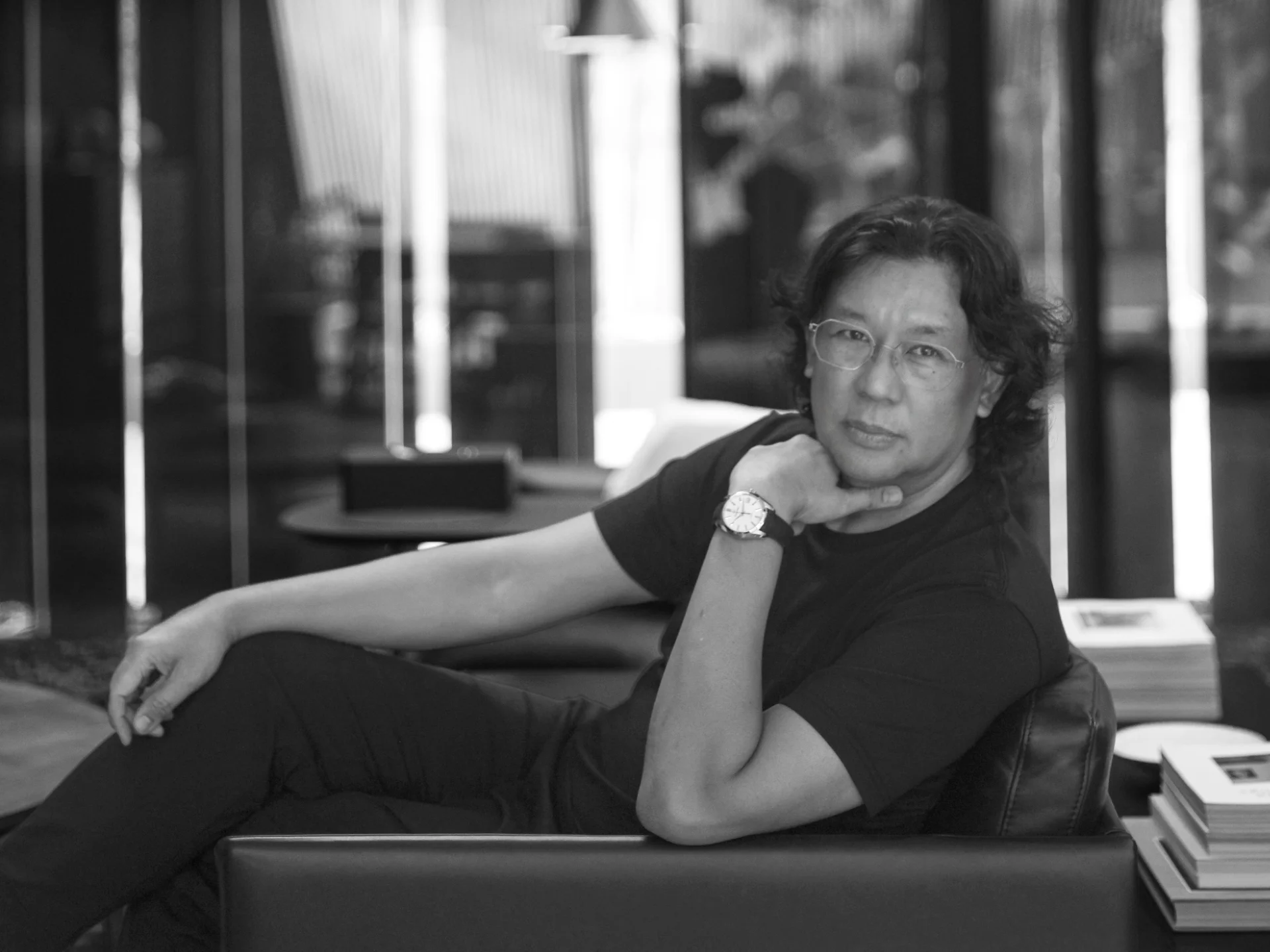
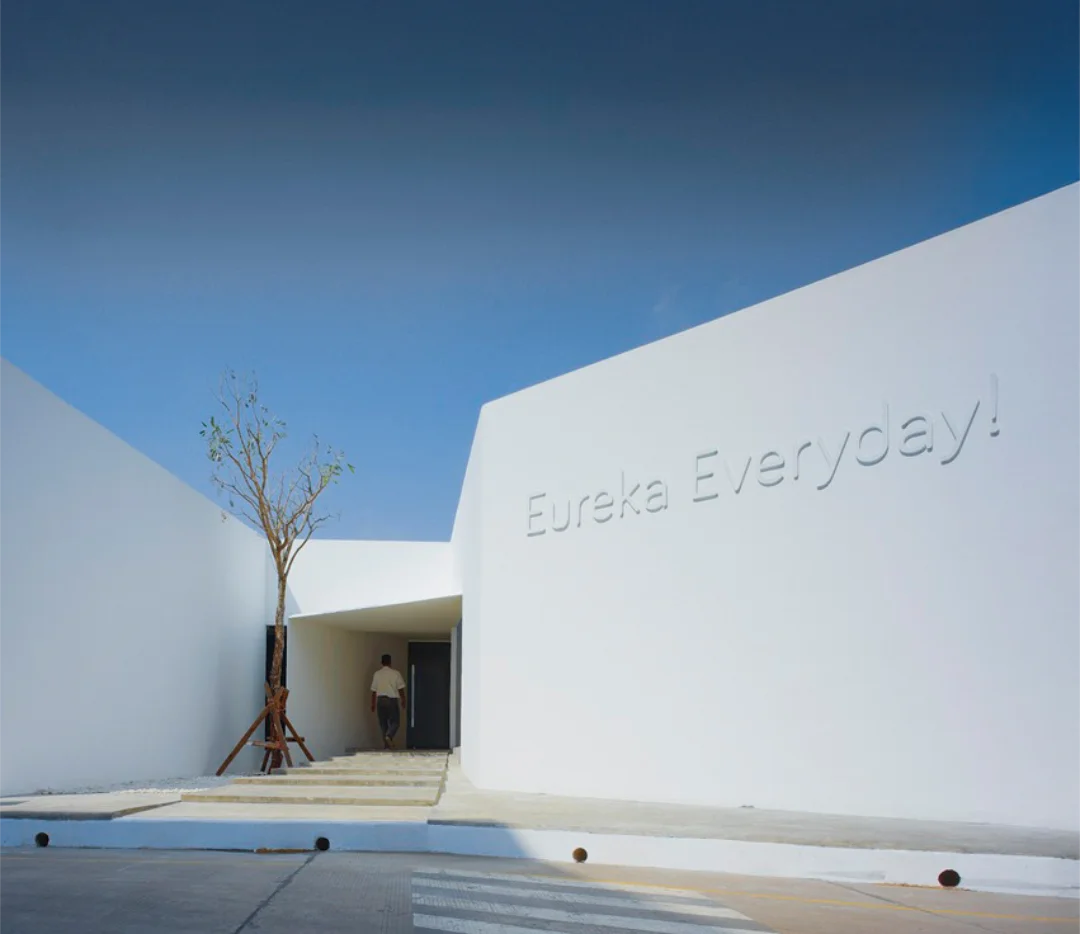
DESIGNED BY
RAUL RENANDA
About Architecture And Design Approach
Welcome. This probably doesn’t feel like a designer’s website should feel, and that’s on purpose. I’d rather just talk to you directly. We’re not a typical design team at Raul Renanda Design either.
Everything you see here — every photo, every rendering — came out of my studio. My team works hard and learns hard, with my direction and mentoring. They’re a mirror of me. Same care for the craft.
People ask me all the time who I am, after thirty years of designing so many different things. I never have a short answer. So let me just show you the work and tell you what’s behind it.
What do I actually do? Buildings and interiors. That’s my bread and butter.
Now, you’ll probably notice the work looks different from one project to the next. Why? Honestly, because I’m interested in the problem, not in repeating myself. But look a little longer and you’ll see the pattern. Geometric. Fairly masculine. And I pay attention to the past while trying to see the future — not to copy what’s been done, but because a building has to feel familiar to the people living in it, and it still has to make sense in twenty years.
Think of a chef. A good chef can cook something new, outside their own tradition. But their hands know what they know, and their tongue decides. It still tastes like that chef.
Every project has to give something to two people. To you, and to me.
Mine is this: I can look at work I did thirty years ago and it still speaks. It’s still relevant. Not because I predicted anything, but because there was a grounded idea underneath it — a reason it was what it was. That’s what makes a design last.
Yours is simpler. There’s the pride when it’s finished, of course. It should feel different, but not outrageous, not trying to prove something. Calm confidence. But the real measure? Do you love using the space. Do you want to stay in it. That’s how I know it worked.
Sounds simple. It takes careful attention, and that attention is what I promise you on every project.
And we build it together. My ideas can be bold sometimes, but I do listen — because in the end it’s your project, not mine. You’re trusting me with your hard-earned money, your time, your budget. You’re the one who’ll live with it, take care of it, benefit from it.
That trust isn’t about my ego, or my name, or anything I’ve done before. You’ve handed me your project, and my team and I give it everything. That’s really all it is.
And I don’t assume I know everything about your life. I’ve been wrong before — corrected by clients who understood their own habits, their own family, their own business far better than I did. Some of the best ideas in my projects didn’t come from me. I’ve learned to listen for them.
Solving the challenges is the part I enjoy most. But knowing you, and having a good relationship during the project and long after it’s finished — that’s my main focus. Not the building. That part follows.
So, about me.
I was born in 1970 and studied architecture at Universitas Katolik Parahyangan, graduating in 1994. I started at Atelier 6 in Jakarta, where I learned to think bigger than the design brief. Then Singapore, twice — first with William Lim Associates, then with 3P Architects, where I learned professionalism and how to manage time and budget. I went to New Zealand to study Indonesian vernacular architecture while working remotely with a Singapore firm, came back through Singapore, and started my own practice in Jakarta around 2002. First with a partner, as Terrada Design. Then on my own, as Raul Renanda Design.
I have two studios. One in Jakarta, where I am most of the time, and one in Ubud Valley in Bali, next to my art gallery. I go down to Bali about once a month to see my team and the projects there. I’ll work anywhere in Indonesia, and I’ve worked internationally — built work in Singapore, concept work in Dubai, Abu Dhabi, and Australia.
What I’ve realized over the years is that my work sits somewhere between consultancy and my own expression as a designer.
There’s no single right way to do this. Every project is different. Every client is different. So I treat each one differently — the type, the challenge, the budget, whatever constraints you’re working within.
In practice, you’ll probably come to me in one of three ways.
Maybe you genuinely need my help to build the thing you’ve been dreaming about. Then I use my experience, my expertise, whatever I know, to make it happen for you. Mostly I’m guiding you through function, materials, color, and budget. A lot of commercial work sits here — the Telkomsel interiors, the train, the Nusantara Explorer, and much of the classical architecture.
Or maybe you want to work together. A real collaboration. Your input, my input, and we build it between us. Tompi — the jazz singer and aesthetic doctor — is a good example. So is the speaker design I did with Indra Lesmana and Aksan Sjuman, two legendary musicians.
Or the third, which is rarer. You respect what I do, you hand me the vision, and you trust me to keep my hands on it. Ben Atelier and the Anyer villa are the examples there.
None of these is better than the others. But it helps if we both know which one we’re in from the start.
I manage and design most projects personally. My team handles some, usually when the budget or other constraints call for it.
And yes, on paper this is contractual work. I make a living from design, you get someone who can solve your problem. Business as usual. But underneath, it’s always a relationship between two people — with emotion, hope, respect, and chemistry. I don’t look at size. One villa or a multi-building development, I don’t care how big or small it is, or where it is. If it’s genuinely challenging — the budget, the timeline, the expectations, or the need for something one of a kind — we’ll take it.
And the reasons vary more than people realize. Sometimes it’s the form. Sometimes the complexity, a real challenge. And sometimes, honestly, it’s just that I like you as a person.
About twenty years ago I had a fairly big studio, and I found we weren’t working as fast as I wanted. So I built a small dedicated team instead, supported by relationships with larger studios. We work fast, efficiently, and — surprisingly — at lower cost. I know everyone personally, and that matters. They can reach me any time. I’d rather have a few people who understand how my brain works than a lot of people I barely talk to.
Now, here’s the thing people neglect, and it’s the most important thing there is. The concept. The first idea.
I develop that with you directly.
The concept stage is where your project gets decided. A lot of designers rush through it. Make something that looks impressive, get you excited, deal with reality later. Then they spend the rest of the project fixing and changing things during construction.
This is wrong. It costs you budget, it costs you time, and it costs you your vision — because what gets built ends up far from what you were shown. It’s been common practice for years. It isn’t how we work.
I do it the other way around. Most of our time goes into thinking, rethinking, and asking whether a decision is actually right.
Because a wrong concept gives you a wrong project, no matter how well it’s built. The rest is technical — how to make it happen, and how to make it easier for the contractor, so they can do what they do best.
Behind us there’s a network of supporting companies and consultants for the work that doesn’t need to be ours — the routine things that eat time. My team stays on the part that makes something special. That’s how a small team handles everything from a small house to a large building, without the delay and cost of a big firm.
Roughly, I work to something like a seventy-thirty rule.
Seventy percent of a building should be common sense. Practical, functional, easy to build, using materials that are available and affordable. The remaining thirty is where the design really lives. Sometimes it’s twenty. On a commercial project it might be ten, because those are sensitive to time and budget.
How far we push the detail depends on what your building needs and what you want. Some people want minimal and quiet. Some want bold.
What changes most is scale.
If you’re building a house, every bit of spending has to be thought through, and the design has to sit inside what your builder can actually do. There’s room to play with detail, even at an artisan level, when it’s for your own home.
On a large project, it’s more about construction strategy. Details still matter, but the building system is what you have to get right, because that’s where the cost is. Anything modular or repeating has to be practical and easy to build. That’s what holds your budget. In that world the small details matter far less. Almost the opposite way of working.
Which is why no two projects are alike. And no two clients are either.
That’s the overall thinking. Now let me talk about design itself.
Modern design has to reflect the person, and the society it’s made in. Modern in the West isn’t modern in Asia. There are values here, symbolic things, that don’t exist anywhere else. Indonesia has its own character, whether we admit it or not, and it affects how we think. Our minimalism isn’t as minimal as the Scandinavian or Japanese version. Ours is warmer — pun intended — and it has emotion. Have you ever met an Indonesian who’s boring and robotic by nature?
I also do classical work, which surprises people who only know my recent work.
It started in 2002, when a client asked for it and I had to learn it from scratch. I love history and culture, so I didn’t mind. For one project I went to Paris many times, to study the French classical period and, more importantly, to understand how those buildings actually get built. In detail. Then I had to work out how to make it work in Indonesia.
It translated more seamlessly than people expect, especially on larger buildings — which is the opposite of what most people assume. Even some architects assume it. I’ve been there and built one. The Bukit Golf Pondok Indah house is the example. Every stone carved by hand, exactly the way they do it there.
For smaller houses I look at the Dutch colonial buildings here instead. That’s the better reference — they studied this climate a long time ago. Though remember, Jakarta, Bandung, and Surabaya had a very different climate back then.
Why does so much classical work in Jakarta fail? In my opinion it’s simple. People plan the building in a modern way and then stick classical details on top. It doesn’t work like that. The height, the size, the location of your site — those decide which classical language is even possible. That said, there are architects here doing so-called neo-classical work very, very well.
I also designed a Chinese peranakan-style house near SCBD. For that I studied traditional Chinese houses and mixed them with colonial style, the way peranakan communities across Southeast Asia built for generations.
For me, design is like music.
My father brought both jazz and classical into the house when I was a child. My taste went to jazz, because of the freedom in the improvisation. But most jazz players trained classically first. That’s how I see my own work. The modern design is strong because the classical training sits underneath it.
Product Design
Product design is something I’m genuinely passionate about.
Whatever I make, I’m really making a sculptural object. Something three-dimensional you can connect with. That’s true in architecture, in interiors, and it’s true here. It’s the form itself, and the material, doing the expressing.
For me, product design sits between art and design. You’re making something emotional that also has to function. That combination is the best part of it.
It wasn’t easy to get here. I trained as an architect, not an industrial designer. And Indonesia doesn’t really have a product culture — our industry is mostly OEM, making things for other people, other brands, other designers, rather than creating our own product and our own brand.
So it took a long time before I could make the things I wanted to make.
Then everything lined up, and my first real product was a grand piano. A full concert grand.
A piano has presence. It isn’t just an instrument, it’s a tool for making art — so the tool itself should be beautiful before it creates any other beauty. That’s why it mattered to me. And I love playing piano. Not well. I never studied formally.
Technically, it’s less difficult than you’d think.
There’s a lot of myth around piano-making. People have been building them for over a hundred years with simple tools.
The hard part isn’t the technical side, it’s the refinement — and on that I agree completely. So for the refinement, the action and the system, I used the best specialist suppliers in the world and combined them. The rest — the wood, the form — we designed and developed ourselves. Indonesian furniture craftsmanship is extraordinary, though only a handful of people here work at this level. But a piano is really just wood and metal. Nothing about it is rare, or high-tech, or impossibly expensive.
The speakers came out of that. Did you know Bentley uses speakers made in Indonesia? Designing speakers came naturally to us, because the piano I designed is also a MIDI instrument, so some of the accompaniment comes through speakers. They became the acoustic companion to the instrument.
Besides the piano and the speakers, automotive design is probably my first love.
Like a lot of boys who loved to draw, the car was the thing I drew most. As far as product design goes, a car is the ultimate object.
Again, we don’t have the culture for it here. Was I born in the wrong place?
Luckily, in 2024 and 2025 I was part of the national car project — the i2C project. Not the Maung, in case you were wondering. We worked with the design maestros at Italdesign in Turin, the studio Giugiaro founded.
Alongside that I have my own project, rebodying a Porsche Cayman as a gentleman’s GT car, as a way to really understand car design. And another one reimagining the early Toyota Kijang.
Those are still conceptual. The i2C national car was shown at GIIAS in Jakarta in late 2025.
And then there’s the yacht.
It’s being built right now. It came from the piano, actually. A client was interested in the piano, and during the conversation it came out that the piano’s concept had started from sailboats. So he asked me to design the yacht. We designed it during the pandemic, aimed at the US market, and got a good conceptual response and real support from the international yacht industry. It’s being built in Antalya, Turkey, ready to be fitted out and brought to the States.
The most recent project isn’t purely product design — it sits between automotive and interior. That’s the train.
Everything is in that one. My classical background, with an Indonesian flavor. It’s the Nusantara Explorer. Indonesian pattern throughout — I designed close to thirty specific batik patterns for the interior, looking for the place between traditional and contemporary. I also designed the Kawung batik pattern for the exterior livery.
Indonesian heritage with modern thinking and approach. That’s what I was exploring there. And that’s exactly the approach that carries into my art. Tompi Residence – Jakarta The Awakening SR 1928 – Concert Grand Piano Lesmana Sjuman Renanda – Studio Monitor Skayr 40 Renanda – Yacht i2C Mobnas Project
Now, About Art
Art was there before everything else. Before design, what I actually knew I wanted to be was a painter and a sculptor.
It goes back to when I was about four. My mother had bought two paintings. One from Bali — a big, highly detailed piece of a Ngaben ceremony, which still impresses me now. But the one that struck me was an abstract by Amri Yahya, bought in Yogyakarta, from before he became known for his batik paintings. A 1973 painting. Abstract. And the idea of abstraction has spoken to me ever since — more than realism, more than showing things as they are.
I painted on and off through my teens and after university, but never seriously. My real commitment came late. I was forty-two. I’d been hosting a television program about architecture, and I interviewed the maestro Arifien Neif. Our styles are completely different, but something he said stuck with me, and I built it from there.
My first solo exhibition was in 2017, when I was forty-seven. Since then I’ve worked seriously in abstract expression.
The colors are usually very basic. Red, black, white, their derivatives, and gold. One period was different — I spent three months painting near Cyril Kongo’s studio at the Apurva Kempinski in Bali. He works in a graffiti style with a lot of color, and I experimented with color then. Otherwise I keep the expression as simple as I can.
The work looks easy to make. That’s deliberate. I don’t want anything standing between me and what I’m feeling at that moment. But it’s hard precisely because it’s technically easy. Besides standard oil and acrylic, I also use architectural paint — a nod to the other half of what I do.
It’s easy to go wrong if my feeling isn’t right. Or worse, if I bring my design thinking into the painting. The smallest intention to make it balanced, or to impress someone the way a designer is supposed to, and it turns decorative. Something honest has to come through me, without interruption. What you end up seeing is maybe one out of five attempts. The rest fail, because the expression isn’t honest. That part is very hard.
I’ve also worked sculpturally in metal, which sits between my practice as a designer of buildings and expression as pure as I can make it.
The one that brings everything together is installation. That’s where it all merges. In 2017 I showed an installation in Yogyakarta using optics and metal, built around the idea of ancestry — that we all migrated here from somewhere, and became one culture. For someone working across as many disciplines as I do, installation is the best way to put the expression.
Photography I’m still working out. I was very active about fifteen years ago, shooting street photography as part of a community here — we exhibited and made a book together, as a group we called IDL, the Leica enthusiasts. I trained with two established American photographers, Alex Webb and later David Alan Harvey. That’s where I found myself in street photography. But photography as art, as my own true expression? I’m still working on that.
Writing And Teaching
My early career was shaped by two mentors. Really, my whole direction came from a few senior people who cared about me.
Without their help, without them inspiring me, I wouldn’t have the life I have now. I do feel blessed by it. I still wonder sometimes what would have become of me if they hadn’t been there.
Architecture saved my life. I don’t mean that lightly. It’s more profound than it sounds.
So I try to do the same for younger people.
Living as an architect, a designer, an artist — it can be hard to get support from your family, or from your community, because most of us come from a background completely different from what we’ve chosen.
Sharing what I know became a kind of calling.
It started with going around campuses, talking to students all over Indonesia. Then a blog. Then the blog became a book — *99 Untuk Arsitek*, a simple manual for young architects and students, and for people in other careers too. From there I kept writing. I had a monthly column in Media Indonesia for almost four years.
That led to television. Sixty episodes of a program called Dulux Inspire, later Dulux Let’s Colour, on Metro TV — interviewing architects and visiting the projects they’d built.
The second book was *Mencuri Kreativitas Desainer*, a design thinking book for entrepreneurs, and that led to teaching. I spent three years on the design thinking course at Prasetiya Mulya, on the master’s and MBA programs.
I still do it. Just on different platforms now.
Thatʼs About It
That’s the introduction.
I never work alone. There are people around me supporting the work all the time. Even as the lead designer, we work with professional conduct — focused on time, on budget, so your project actually gets built the way you expect.
It’s easy to look at all this and see a man with no clear focus.
But it comes from one mind. One mindset.
Design and art are what I make. The object can be anything — a small house, a large building, any useful thing.
It always starts the same way. Conceptual thinking. The design approach. Understanding what you’re really trying to achieve. Building the team. Managing construction. And what comes after — branding, the logo, even the marketing concept around it.
Because you need to understand what you’re expressing to the people around you, whether that’s personal or business. Everything we do points at that.
So if you’ve read this far, and you have something in mind — just message me on WhatsApp. Tell me about it.
A few people hesitate because they assume it’s expensive, or that contacting me starts some formal process. It doesn’t. The first conversation costs nothing and commits you to nothing. And when it comes to fees, I’d rather talk about it openly and early, so we both know where we stand before anyone gets attached to an idea. Every project is different, so the honest answer is that it depends — but you’ll never have to guess, and you’ll never have to feel awkward asking.
Let’s talk, and see whether we can turn your idea, your business, your dream project into something real.
Let’s make something great, together.